
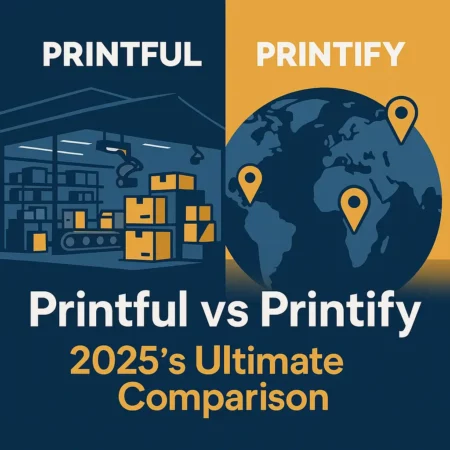
If you’re exploring the world of print-on-demand, you’ve likely come across the two most popular platforms in the space: Printful and Printify. On the surface, they may seem nearly identical—both allow you to create and sell custom products without holding inventory or managing shipments. But dig a little deeper, and the differences start to matter.
In this Printful vs Printify comparison, we’re not here to declare a winner. Instead, we’ll explore the real-world pros, cons, and use cases for each platform to help you make the smartest choice for your business in 2025. Whether you’re launching your first online store or scaling an existing one, understanding how these platforms differ in pricing, product variety, fulfillment, and integrations could save you time, money, and unnecessary headaches.
By the end, you’ll know exactly which platform fits your goals—or how using both Printful and Printify together might be the secret sauce for maximizing profit and flexibility.
Business Model Differences
At first glance, Printful and Printify may appear to offer the same service: print-on-demand fulfillment for custom merchandise. But the way each company operates behind the scenes reveals some key differences that can affect your product quality, shipping times, and overall customer experience.
Printful’s In-House Production Model
Printful operates its own in-house production facilities across North America, Europe, and other regions. This means they directly manage the printing, packing, and shipping of every order placed through their platform. With this level of control, Printful ensures consistency in product quality and fulfillment times, making it a great choice for sellers who prioritize reliability and brand reputation.
They also offer additional services like custom labels, branded packaging, pack-ins, and even warehousing—ideal for sellers wanting to build a more premium or personalized customer experience.
Printify’s Print Provider Network
In contrast, Printify acts more like a middleman. They partner with a vast network of third-party print providers located around the world. This setup gives sellers access to over 1,300 products, often at lower base prices than Printful. You can choose your provider based on location, pricing, and customer ratings—offering more flexibility but introducing variability in quality and fulfillment.
While this model allows for competitive pricing and diverse product options, it also means you’re trusting a third-party vendor to deliver on Printify’s behalf. This can lead to occasional inconsistencies depending on which provider you choose.
Which Business Model Works Best?
If your top priorities are quality control, reliable delivery times, and premium branding, Printful’s vertically integrated model may give you an edge. But if you’re focused on price flexibility, product diversity, or international fulfillment options, Printify’s network approach can be a powerful advantage—especially when paired with their Premium Plan, which offers up to 20% off product pricing.
Some sellers even use both platforms together, selecting the best option per product or region.
Product Range and Customization Options
One of the most important factors in choosing a print-on-demand partner is the variety of products you can offer—and how much control you have over their design and branding. When comparing Printful vs Printify, both platforms deliver strong options, but with some notable differences that can influence your decision.
Printify’s Massive Product Catalog
Thanks to its large network of third-party print providers, Printify boasts a catalog of over 1,300 products. From t-shirts, hoodies, and mugs to more unique items like dog beds, jewelry, and yoga mats, the range is hard to beat. This broad selection gives sellers the flexibility to experiment with niche markets or create a diverse product line without adding inventory.
However, customization options can vary depending on the provider. While some allow front, back, and sleeve prints, others may only support a single print area. Mockup quality and branding features also differ between providers, so it’s important to review those details before committing to a specific product.
Printful’s Streamlined but High-Quality Offering
Printful, on the other hand, offers around 390 carefully curated products, all produced in-house or by trusted fulfillment partners under their direct oversight. While the selection isn’t as vast as Printify’s, it includes the most popular and profitable items in the POD space—such as premium apparel, accessories, wall art, and home goods.
What Printful may lack in quantity, it makes up for in consistency, quality, and branding capabilities. Every product supports professional mockups, and sellers can take advantage of features like:
Inside/outside labels
Custom packaging slips
Branded pack-ins
Personalized embroidery options
This makes Printful an excellent option for building a professional, cohesive brand from the start.
Comparing the Experience
If you’re aiming to test a wide range of products across various niches, Printify’s extensive catalog is hard to ignore. But if you’re focused on building a polished, premium brand with consistent customization and high-end presentation, Printful’s offerings and advanced branding options are designed with you in mind.
And yes—you can absolutely do both. For example, use Printify to experiment with trend-driven or seasonal items, while keeping your best-selling core products on Printful for top-notch branding and customer experience.
Pricing and Plans
When choosing between Printful vs Printify, pricing often becomes the deciding factor—especially for new sellers on a tight budget or those scaling up with high order volumes. While both platforms are technically free to start, the way they structure pricing and available discounts differs significantly.
Printify’s Free and Premium Plans
Printify offers a flexible pricing structure that appeals to both beginners and high-volume sellers.
Free Plan: Includes full access to Printify’s product catalog and marketplace of print providers. There are no upfront costs—you only pay when a customer places an order.
Premium Plan ($29/month): Unlocks up to 20% off all product prices, which can make a major difference in your profit margins if you’re processing regular sales.
This makes Printify a strong choice if you’re looking to test products or scale aggressively while keeping costs low. It’s especially attractive for entrepreneurs running Shopify stores (Shopify) or using marketplaces like Etsy.
👉 Try Printify with or without Premium
Printful’s On-Demand Pricing with Volume Discounts
Printful takes a different approach. There are no paid plans or monthly fees—all sellers use the platform for free and simply pay per order. However, as your sales increase, you’ll unlock volume-based discounts through Printful’s Growth Program:
Up to 33% off select apparel
Up to 15–20% off on accessories and home goods
25% off on sample orders (great for testing product quality or photographing inventory)
This rewards sellers who are already generating solid sales and want to maintain quality while increasing profit margins—without needing a subscription.
👉 Explore Printful’s discount structure
Which Pricing Model Is Right for You?
If you’re just starting out and want to test the waters with minimal upfront cost, Printify’s Free Plan gets you going quickly—and the Premium Plan becomes a smart move as you grow. If you’re more focused on long-term branding, quality, and streamlined operations, Printful’s volume discounts and no monthly fees could offer better value over time.
For many sellers, the winning strategy is to leverage both: use Printify’s low-cost providers to test new products or appeal to price-sensitive markets, while relying on Printful for high-margin, high-quality staples.
Shipping and Fulfillment
Reliable shipping and fast fulfillment can make or break your print-on-demand business. Customers expect clear delivery timelines and smooth order tracking, especially when shopping online. In this section of our Printful vs Printify comparison, we’ll look at how each platform handles fulfillment logistics—and how those differences could affect your bottom line and customer satisfaction.
Printful’s In-House Fulfillment and Global Warehouses
One of Printful’s biggest strengths is its in-house production and fulfillment network. With facilities across the United States, Canada, Europe, and other regions, Printful controls nearly every part of the process—from printing to packing to shipping.
What this means for you:
Faster and more predictable shipping times
Better quality control, since products don’t leave Printful’s ecosystem
Centralized customer service if any issues arise
Printful also offers optional warehousing services, allowing you to store non-Printful products and have them shipped with the same level of care. This is ideal for hybrid brands that also sell books, stickers, or third-party merchandise.
👉 Explore Printful’s fulfillment network
Printify’s Decentralized Fulfillment Approach
Printify uses a global network of third-party print providers, meaning your product could ship from dozens of different companies depending on the provider you choose. While this gives you greater flexibility in pricing and product variety, it can also lead to:
Inconsistent shipping speeds
Variable customer experiences depending on location and print partner
Separate customer service chains, as Printify acts more as a broker
Shipping costs and delivery times vary by provider and destination, so it’s important to review each partner’s shipping profiles before publishing a product. That said, this model can be highly efficient if you carefully select providers with positive reviews and local production near your target audience.
👉 Browse Printify’s provider network
Delivery Time and Reliability: What to Expect
In general:
Printful provides more consistent and professional fulfillment, making it ideal for premium branding or selling to repeat customers.
Printify may offer faster local shipping if you choose a nearby provider—but you’ll need to monitor quality and timing across different vendors.
If international reach is important to your store, consider mixing and matching:
Use Printful for US, Canada, and EU fulfillment.
Use Printify for products or regions Printful doesn’t serve efficiently.

Integrations and Store Compatibility
When it comes to building a seamless ecommerce workflow, integration matters. Both Printful and Printify offer plugins and apps to connect with the most popular online store platforms, but the ease of use and available features can vary. Let’s break down how each platform stacks up in this key area of the Printful vs Printify comparison.
Printful Integrations: Polished and Built for Scale
Printful offers direct, well-maintained integrations with major ecommerce platforms and marketplaces, including:
Etsy
WooCommerce
Wix
Squarespace
BigCommerce
Amazon
eBay
Setup is typically smooth, with auto-syncing of product listings, order tracking, and inventory updates. Printful also offers an API for custom integrations if you’re building your own website or using a headless commerce approach.
Bonus: If you’re using WordPress, Printful works seamlessly with Elementor (Elementor review) and the Rank Math SEO plugin (Rank Math review) for optimized site performance.
Printify Integrations: Flexible and Expanding
Printify also offers solid integration with popular ecommerce platforms, including:
Shopify
Etsy
WooCommerce
Wix
BigCommerce
PrestaShop
eBay (via third-party apps)
While not as expansive as Printful’s ecosystem, Printify still covers all the essentials for most sellers. You can publish products, sync orders automatically, and connect multiple stores under one account—especially useful if you’re testing different niches or managing client stores as a Fiverr freelancer.
If you’re using Systeme.io as a lightweight ecommerce option (Systeme.io review), keep in mind that neither platform offers native integration—but you can work around this using manual order forwarding or Zapier.
Which Platform Wins on Integrations?
In the Printful vs Printify debate, both platforms offer enough integrations to get you selling fast. However:
Printful is often the better fit for sellers scaling across multiple platforms or looking for tight backend automation.
Printify provides the essential integrations without locking you into a monthly plan, making it ideal for testing or running lean.
Printful vs Printify: Use Cases and When to Choose Each
At this point, you understand the major differences between Printful and Printify. But which one is actually the right fit for your business? The answer depends on your goals, experience level, branding needs, and budget.
Before we jump into specific scenarios, here’s a quick side-by-side breakdown to help clarify their strengths:
Printful vs Printify Comparison Chart
| Feature | Printful | Printify |
|---|---|---|
| Business Model | In-house production & fulfillment | Network of third-party print providers |
| Product Range | ~390 curated products | 1,300+ products across multiple suppliers |
| Branding Options | Advanced (labels, pack-ins, custom packaging) | Limited (varies by print provider) |
| Pricing Structure | Pay-per-order + volume discounts | Free Plan or Premium Plan ($29/month) with up to 20% off |
| Shipping Control | Consistent and managed by Printful | Varies by print provider |
| Fulfillment Locations | USA, EU, Canada, and more | Global (based on provider selection) |
| Integrations | Wide range (Shopify, Etsy, WooCommerce, Amazon, etc.) | Essential platforms supported (Shopify, Etsy, WooCommerce, etc.) |
| Sample Order Discount | Yes (up to 25% off) | No sample discount on free or premium plan |
| Customer Support | Centralized and handled by Printful | Support split between Printify and provider |
| Best For | Quality-focused brands, premium ecommerce stores | Budget-conscious sellers, product testers, global fulfillment flexibility |
When to Choose Printful
Choose Printful if you:
Want full control over product quality and fulfillment
Need custom branding and premium packaging
Are scaling a long-term ecommerce brand
Prefer working with a single fulfillment source
Sell on multiple platforms and want seamless automation
When to Choose Printify
Choose Printify if you:
Want access to a huge variety of products
Are optimizing for low base costs and higher margins
Are testing multiple product ideas or niches
Want to fulfill orders from different global regions
Don’t mind researching and managing different print providers
Can You Use Both Printful and Printify Together?
Absolutely—and in many cases, it’s the smartest approach.
While much of the conversation around Printful vs Printify assumes you must choose one, savvy sellers often use both platforms in tandem to maximize flexibility, coverage, and profits. Since neither platform requires exclusivity or long-term contracts, you’re free to mix and match based on what’s best for your business.
Why Use Both?
Here are a few use-case examples where using Printful and Printify together makes perfect sense:
✅ Product Testing and Expansion
Use Printify to test new or niche products thanks to their larger catalog and lower base prices.
If a product becomes a bestseller, consider migrating it to Printful for better quality control, branding, and fulfillment consistency.
✅ International Fulfillment
Printify’s provider network includes global printers, which may reduce shipping costs and delivery times for customers in regions not well-served by Printful.
Meanwhile, Printful’s own fulfillment centers cover key regions like the U.S., Canada, and Europe with speed and reliability.
✅ Tiered Branding Strategy
Offer premium products through Printful with custom labels and packaging for your main brand.
Sell budget-friendly versions of the same items through Printify for price-sensitive shoppers or alternate storefronts.
✅ Backup Fulfillment Plan
If one platform is out of stock, facing delays, or having technical issues, you can quickly switch to the other—ensuring business continuity and better customer satisfaction.
How to Manage Both Efficiently
Running both platforms is easier than it sounds, especially with the help of tools like:
Shopify for managing products from multiple sources
Order routing plugins or manual order filtering based on product type or location
A centralized design and branding system using tools like Envato Elements to keep everything consistent across platforms
While it does require a bit more organization, using both Printful and Printify together lets you play to the strengths of each without being locked into a single model.

Final Thoughts: Choosing the Right POD Partner for You
When it comes to Printful vs Printify, there’s no one-size-fits-all answer. Each platform brings unique strengths to the table—and your choice ultimately depends on your goals, budget, and brand priorities.
If you value consistent quality, professional branding, and reliable fulfillment, Printful is a rock-solid choice—especially for businesses building a premium brand experience. On the other hand, if you’re looking to maximize profit margins, test a wide range of products, or expand internationally, Printify’s diverse provider network and competitive pricing are hard to beat.
And remember: you don’t have to pick just one.
Many successful sellers combine both platforms, using Printify for product testing and low-cost experimentation, while relying on Printful for their flagship items and customer-facing brand identity. It’s a flexible, scalable strategy that allows you to adapt as your business grows.
Whether you’re just starting out or refining an existing store, the key is understanding how these tools work—and using them intentionally to meet your business goals.